
Pilot offer Get 10% off Verify credit packages with code PILOT10.
Start verifyingWhat the screening covers.
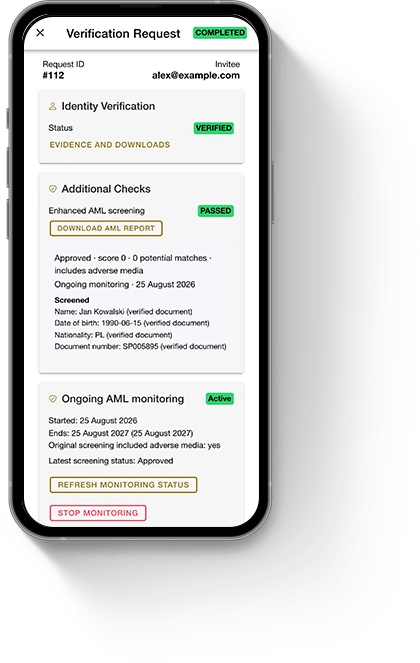
Screening runs against the same request that collects your client's documents and verifies their identity, so the result sits with the evidence rather than in a separate tool.
The standard check covers sanctions, watchlist and politically exposed person data. The enhanced option adds adverse-media screening. Ongoing monitoring re-screens a person you have already checked for twelve months.

AML screening
Verify screens the person against sanctions, watchlist and politically exposed person data, and returns the possible matches with the match and source information available in the result for your team to review.

AML screening with adverse media
Everything in the standard screening, plus a search of adverse-media and news reporting associated with financial crime, including money laundering and embezzlement; violent crime; terrorism; narcotics and drug trafficking; fraud and deceptive practices; and regulatory violations. UMNIII Verify returns the possible media matches and the supporting information available in the result, for your team to review.

Twelve months of monitoring
Add ongoing monitoring to someone Verify has screened and they are re-screened across the term. Your team can check the current position whenever you need it, monitoring is priced per person rather than as a platform-wide subscription, and it stops automatically when the paid term ends.

The result, and your review
Verify provides the screening report and the supporting evidence available with it, and records every review your team makes. What you end up with is an organised account of what was searched, when it ran and what you decided.
Know what was checked, when it ran and what you decided.
Know what was checked, and when
Every screening returns a time-stamped result showing what was searched and what came back: sanctions, watchlist and politically exposed person data as standard, with adverse-media screening on the enhanced option. When somebody asks months later what you checked before taking this client on, the answer is on the file with the date against it.
UMNIII Verify screens against sanctions, watchlist, PEP and news sources, and what any given search covers varies by source and by jurisdiction. UMNIII does not maintain those databases. If a particular jurisdiction or screening requirement matters to your business, tell us what you need and we will confirm the available coverage.
A screening reflects the information returned on the day it ran, so it records what was checked rather than certifying that a person is clear.
Review possible matches with the evidence beside them
Verify returns each possible match together with the match and source information available in the result, so the comparison your team has to make, weighing dates of birth, jurisdictions, spellings and context, happens in one place rather than across three browser tabs and an email thread.
The conclusion your reviewer reaches is recorded against the result, alongside the evidence it was based on, so the reasoning stays with the file instead of in somebody’s recollection.
A possible match is a record that resembles the person you screened and needs review, not a finding about them. Verify does not decide whether the matched person is your customer, and it does not approve or reject the relationship.
Keep selected relationships under review for twelve months
Add monitoring to someone Verify has already screened and they are re-screened across a twelve-month term. Your team can check the current position whenever you need it, every monitoring review you record is kept alongside the original result, anyone in your Workspace with the right permission can stop it early, and it stops automatically at the end of the paid term.
Monitoring is priced per monitored person rather than as a platform-wide subscription, so a firm keeping a handful of higher-risk relationships under review is not paying for the capability across its whole book.
Monitoring means the person continues to be re-screened across the term and that you can check the current position. It is not a guaranteed instant alert the moment something changes.
AML and adverse-media screening FAQs
UMNIII Verify screens the person against sanctions, watchlist and politically exposed person data, and returns the possible matches together with the match and source information available in the result, time-stamped so your team can show what was checked and when. It is a point-in-time search: it reports the information returned on the day it ran.
It includes the sanctions, watchlist and PEP screening above, and additionally searches adverse-media and news reporting associated with financial crime, including money laundering and embezzlement; violent crime; terrorism; narcotics and drug trafficking; fraud and deceptive practices; and regulatory violations. UMNIII Verify returns the possible media matches with the supporting information available in the result, so your team can review what was reported and record what they concluded. It widens where you have looked, beyond the formal lists alone. A possible match is not a finding, and coverage varies by source and by jurisdiction.
Adverse-media screening is one input into enhanced due diligence: it widens where you have looked beyond the formal lists, and it evidences that you looked. It is not the whole process, it does not guarantee detection, and it does not prove that no adverse information exists about a person.
Review it with the information Verify gives you. Each possible match arrives with the match and source detail available in the result, so your team can weigh dates of birth, jurisdictions, spellings and context in one place, and the conclusion you record is kept with the evidence and becomes part of the file. A possible match is a record resembling the person you screened rather than a finding about them: UMNIII Verify does not decide whether the matched person is your customer, and it does not approve or reject the relationship.
UMNIII Verify screens against sanctions, watchlist, PEP and news sources, and the result carries the match and source information available with it. What a given search covers varies by source and by jurisdiction, and UMNIII does not maintain those databases, so we do not publish a fixed list and present it as settled coverage. If a particular jurisdiction or screening requirement matters to your business, tell us what you need and we will confirm the available coverage.
Ongoing monitoring keeps the person under review: they continue to be re-screened across the twelve-month term, and your team can check the current position whenever you need it, alongside the monitoring reviews you have already recorded. Monitoring is re-screening across the term, and it is not a guaranteed instant alert the moment something changes.
Sanctions, watchlist and PEP screening runs against named people. Verifying the business itself is business verification, which can run against the same request and returns the officers and owners where the available records provide them. The KYB page covers that in detail.
UMNIII Verify supports your compliance work and evidences it: you get a time-stamped record of what was screened, the possible matches your team reviewed and the decision they recorded. Compliance itself stays with your firm. Verify does not decide whether to accept a client, it does not guarantee detection, and nothing it produces is legal advice about your obligations.
Per check, using credits, rather than as a recurring platform commitment, and monitoring is priced per monitored person for the term. A firm that screens occasionally pays for the screenings it runs. Sign in to UMNIII Verify and run your first screening when you are ready.
Screening clients as part of onboarding?
Use UMNIII Verify to run sanctions, PEP and adverse-media screening and keep the result with the request.
Start verifyingWhere this sits
UMNIII Verify
The platform this screening runs on: identity, company verification, forms, documents, Workspaces and evidence packs.
KYB and company verification
Registry information where it is available, supporting corporate documents, and the officers and owners the records provide.
UAE supplier verification
Supplier requests carrying the forms, documents and checks your team selects, under FTA Decision No. 13 of 2026.
Need a custom verification solution?
For businesses with more complex requirements, UMNIII Labs can build bespoke verification, onboarding and compliance software around your existing systems and processes.
Custom supplier portals, bespoke KYC and KYB systems, integrations with unrelated CRM, finance and line-of-business systems, complex approval chains, custom risk logic, multi-system workflows, bespoke dashboards and custom APIs.
If UMNIII Verify already covers what you need, that is the faster and less expensive route, and we will tell you so. Standard supplier-data integration, ERP sources included, is available through UMNIII Verify rather than a Labs build.
Screening reports the results returned by the sources searched on the day it ran. UMNIII Verify supports your firm’s compliance work and evidences it: it does not certify that a person is clear, it does not guarantee detection, it does not decide whether a client is acceptable, and nothing on this page is legal advice about your obligations. See UMNIII Verify for the full platform.