
Pilot offer Get 10% off Verify credit packages with code PILOT10.
Start verifyingWhat changed, and who it affects
What changed
UAE Federal Tax Authority Decision No. 13 of 2026 has applied since 1 October 2026. It sets out documented verification expected of taxable businesses in relation to their suppliers and the supplies they receive, before input tax is deducted.
The decision sets out verification in relation to the supplier and, separately, in relation to each supply received. Supplier verification applies when you first deal with a supplier, and again on continued dealings where that supplier has not been verified in the previous twelve months. Supply verification applies to the supplies themselves.
It also asks that the verification carried out is documented and that supporting records are retained so they can be produced to the Federal Tax Authority, and that a business keeps a written policy setting out who carries out, reviews and supervises this work.
The decision includes a limited exception for smaller amounts, which itself stops applying once your total dealings with that supplier pass a higher figure over a twelve-month period. How the thresholds and the exception apply to your business is a question for your own tax adviser.
Who this affects
The decision is addressed to taxable persons: businesses registered for VAT in the UAE, or required to register. It concerns the supplies they receive, and it matters at the point input tax is deducted.
In practice the businesses most affected are those that take on new suppliers regularly, buy from many small or newly formed entities, or operate across several entities and need the same review carried out consistently in each of them. Finance, procurement and compliance teams tend to feel it first, because the work lands with them.
This is not a statement that every UAE business must verify every supplier. Whether, and how, the decision applies to you depends on your circumstances, and it is worth taking advice on that.
What businesses may need to verify.
The decision covers the supplier and the supply separately. Some of it is about establishing who you are dealing with, and some of it is about whether a particular transaction makes commercial sense.
How much of this applies, and how often, depends on the supplier, the amounts involved and your own circumstances. The summary below is a starting point for that conversation, not a checklist to work through.

Who the supplier is
Identity for an individual, or incorporation details confirmed against official databases for a company, together with identification for the director or authorised representative you deal with.

Where they actually operate
That the supplier has a real place of business suited to the activities carried out, established through appropriate electronic means or a field visit.

The supply itself
Whether the transaction makes commercial sense: the rationale, how payment flows, whether pricing sits within a reasonable range, and whether the goods or services fall within the supplier’s licensed activities.

Indicators worth explaining
Circumstances the decision asks businesses to notice and justify in writing, such as repeated changes of address or key personnel, or transactions out of proportion to the supplier’s size and history.
How UMNIII Verify helps.
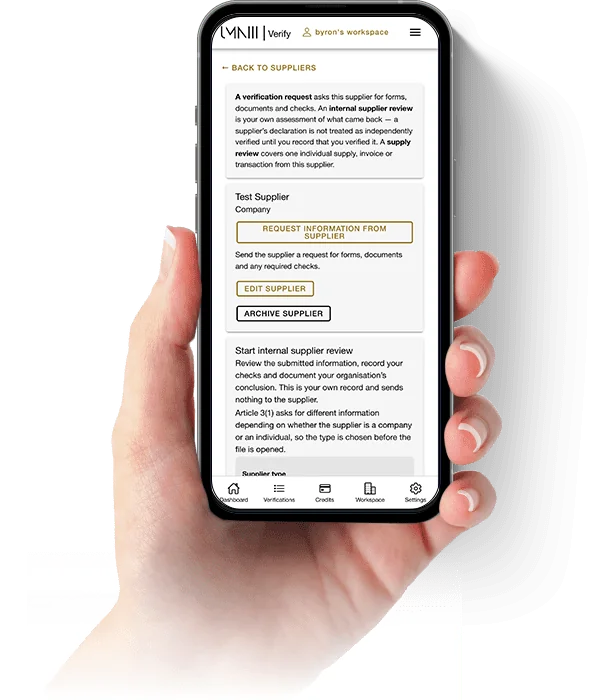
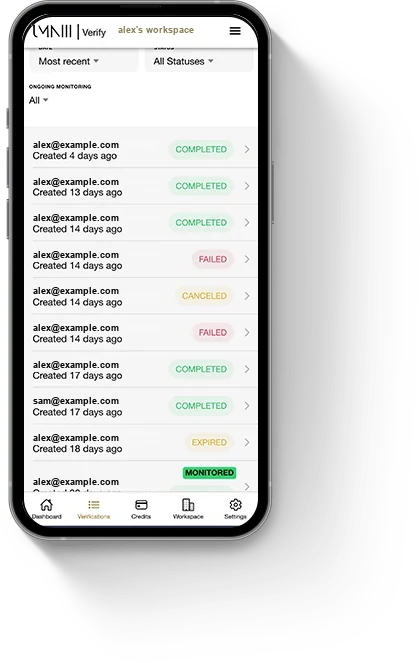
UMNIII Verify gives supplier verification a single structured workflow. You decide what a supplier must provide, send one branded request, and the documents, answers and check results come back against one record instead of arriving piecemeal across email and shared drives.
Your team reviews it in a shared Workspace, tracks what is outstanding, and downloads a branded evidence pack whenever the work has to be shown. Verification dates are tracked too, so you can see when a supplier is due for reverification and manage the next review from the same Workspace.

Collect what you decide to ask for
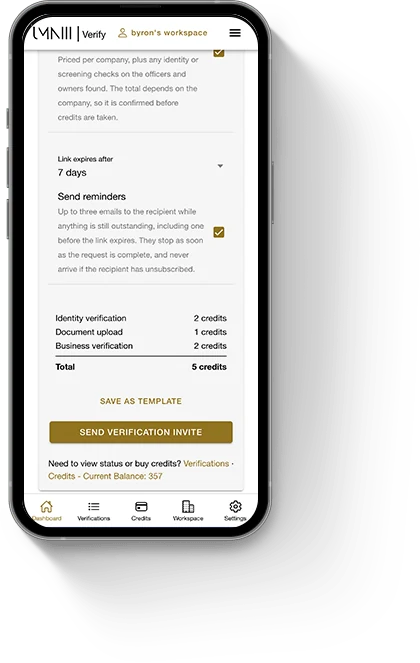
Build a supplier request from configurable forms and document requests, choose the checks it should include, and send it as one branded link. A supplier may be a company or an individual, and bulk send covers a list of them at once.

Run the checks Verify supports
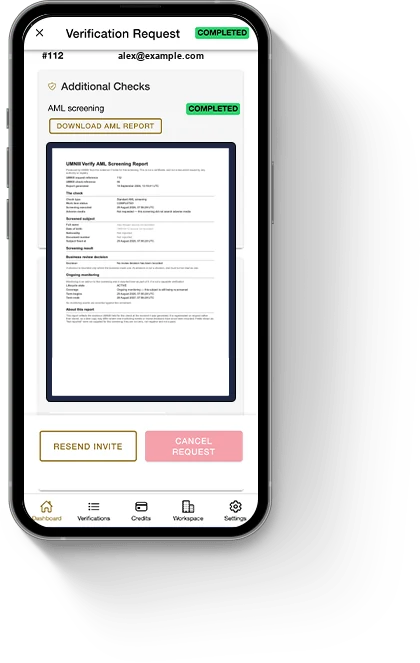
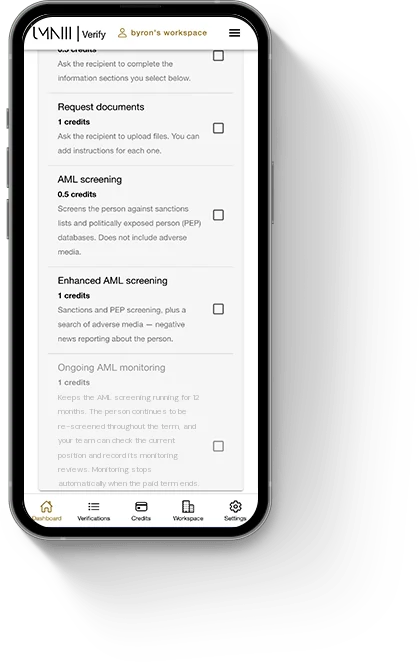
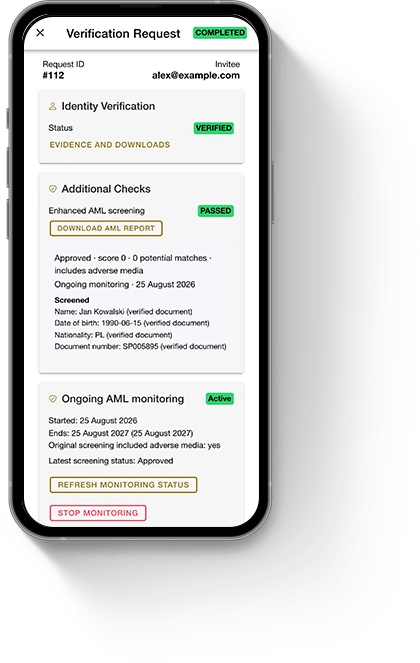
Choose the supported identity, company or AML checks a supplier request should include. They run against the same request, so results arrive on one record rather than in separate tools and inboxes. They do not all run on their own: nothing begins merely because a supplier exists in Verify or has been imported into it.

Review it as a team, and keep it current
Workspaces with members and roles, activity timelines and status tracking. Verification dates are tracked against the supplier, so you can see when reverification is due and manage the next review in the same place.

Keep the evidence together
One branded evidence pack per request, carrying the history, the results and the available evidence. Individual documents, form-response PDFs and reports stay downloadable on their own.
It is not only about onboarding the supplier
A large part of the decision concerns the transaction rather than the counterparty. Alongside knowing who the supplier is, a business is expected to consider whether the supply itself holds together: whether there is a genuine commercial reason for it, whether the payment terms and the route the money takes can be explained, whether the price sits within a range that makes sense, and whether the goods or services are within what the supplier is licensed to do.
Where a third party is involved, or the supplier is acting as an intermediary, the expectation is that the arrangement can be explained rather than simply recorded.
In UMNIII Verify this is form work rather than an automated check. Risk questions, commercial rationale and payment explanations are collected as structured answers against the same case as the supplier’s own record, so the reasoning sits with the evidence instead of in an email thread.
Verification that has to stay current
Supplier verification is not a one-off for a supplier you keep dealing with. The decision looks back over the previous twelve months, so it is a rolling window rather than a fixed annual date, and a supplier you have not looked at within that window may need reviewing again before further dealings.
The practical difficulty is rarely the review itself. It is knowing which of several hundred supplier records is approaching the point where it should be looked at again.
UMNIII Verify tracks supplier verification dates, shows you when reverification is due, and lets you manage the next review from the same Workspace. Verify, track, reverify, with the earlier evidence kept alongside the new request rather than starting over.
Being able to show the work
Carrying out verification and being able to demonstrate it later are two different problems. The decision asks that steps taken are documented and that supporting records are retained so they can be produced on request, which means the useful output is not a pass or fail but an organised record of what was asked, what came back and who reviewed it.
Each request in UMNIII Verify keeps its forms, documents, check results and activity timeline together. One branded evidence pack can be downloaded per request, and individual documents, form-response PDFs and reports remain available separately.
What your business is required to retain, for how long, and on what basis remains yours to determine. UMNIII Verify keeps the material organised and downloadable; it does not decide your retention obligations.
One place for the work, and for showing it
Where the decision calls for an item Verify cannot confirm for you, Verify is still where you request it, hold the response and keep it with the rest of the case. What Verify checked and what the supplier supplied stay together in one case and stay identifiable as what they are, so nobody has to work out later which part was verified and which part was submitted.
The judgements stay where they belong. Whether a supplier is acceptable, whether an explanation is satisfactory and whether input tax should be deducted are judgements for your business, and Verify records what you decided rather than deciding it.
UMNIII Verify does not file or submit anything to the Federal Tax Authority or any other destination system on your behalf, and it does not confirm a UAE trade licence, a UAE place of business or a supplier’s banking arrangements for you. Using it does not by itself make a business compliant with Decision No. 13 of 2026, and nothing on this page is legal or tax advice.
Enterprise supplier integration: available now
A large supplier population, without recreating it by hand
Organisations with thousands of suppliers can bring supplier master data into UMNIII Verify from SAP, Oracle or a structured export, keeping the identifier each supplier already has in your own system and a record of where each contact came from.
Supplier data can be brought in and kept current ahead of any verification, with your tax or compliance team deciding which suppliers to verify, and when.
UAE supplier verification FAQs
It is a UAE Federal Tax Authority decision setting out measures, procedures and conditions for taxable persons to verify the validity and integrity of supplies before deducting input tax. It was issued on 22 July 2026 and takes effect on 1 October 2026. The authoritative text is the Arabic version published by the Federal Tax Authority.
The decision is addressed to taxable persons, concerns the supplies they receive, and matters in relation to deducting input tax. It also contains an exception for smaller amounts, which itself stops applying once dealings with a supplier pass a higher figure over a twelve-month period. So its reach is narrower than a blanket rule, and whether and how it applies to your business is a question for your own tax adviser.
The decision looks back over the previous twelve months, so it is a rolling window rather than a fixed annual date, and whether a given supplier needs reviewing again depends on your dealings with them. UMNIII Verify tracks supplier verification dates, shows you when reverification is due and lets you manage the next review from the same Workspace, keeping the earlier evidence alongside the new request.
It overlaps with it. Many businesses already run some form of supplier due diligence, or vendor screening, when they take on a new counterparty. The decision asks for that work to be documented, to cover the supply as well as the supplier, and to stay current rather than stopping after the first-time verification. UMNIII Verify is where the request goes out, the answers and documents come back, and the record of what was asked, what came back and who reviewed it is kept, for a first verification and for every review after it.
The decision refers to establishing that a supplier has a real place of business suited to its activities, using appropriate electronic means or through a field visit. Either route can satisfy it, so a visit is one way rather than a standing requirement, and which is appropriate in a given case is a judgement for your business.
Verify gives the work a structure: you request the documents and answers you need, run the checks it does support, record your review, and keep everything together as one evidenced record. The UAE-specific confirmations are not among the checks it runs for you, so a trade licence, a place of business or a supplier’s banking arrangements are requested and evidenced in Verify rather than confirmed by it.
The ones your team selects. Company verification, identity verification and AML screening are supported, with ongoing monitoring available, and they run against the same request rather than in separate tools. They do not all run on their own, and nothing begins merely because a supplier exists in Verify or has been imported into it. Alongside the checks you choose, you can collect documents and structured form answers, review them as a team in a shared Workspace, and download a branded evidence pack per request.
UMNIII Verify supports the work: collecting information, running the checks it supports, recording your review and keeping the evidence organised. Whether a supplier is acceptable, whether an explanation is satisfactory and whether input tax should be deducted remain your decisions, and no product can make a business compliant on its own.
Yes. UMNIII Verify supports enterprise supplier integration from SAP, Oracle, other ERP and procurement systems, middleware and structured supplier exports, all arriving through the same standard Integration Source model rather than as a series of one-off builds. What setting one up involves depends on your SAP version, whether you run it in the cloud or on premise, any middleware in front of it, which APIs are available to you, how your fields map to the Verify supplier model and how supplier data will be brought into Verify. Tell us what holds your supplier data and we will work through those with you.
Standard supplier-data integration, ERP sources included, is part of UMNIII Verify now rather than a bespoke Labs build: supplier master data comes in from SAP, Oracle or a structured export through the same standard Integration Source model. UMNIII Labs is for what sits outside the standard product, such as a supplier portal of your own, an integration with an unrelated CRM or line-of-business system, workflows spanning several systems, custom approval logic or custom risk scoring. If UMNIII Verify already does what you need, that is the faster and cheaper route and we will say so.
Sign in to UMNIII Verify, import or add your suppliers and request the information you need. PILOT10 gives 10% off credit packages to start with.
Reviewing how you verify and document suppliers?
Use UMNIII Verify to import and organise suppliers, request the information you need and keep the evidence with each supplier record.
Start verifyingNeed a custom verification solution?
For businesses with more complex requirements, UMNIII Labs can build bespoke verification, onboarding and compliance software around your existing systems and processes.
Custom supplier portals, bespoke KYC and KYB systems, integrations with unrelated CRM, finance and line-of-business systems, complex approval chains, custom risk logic, multi-system workflows, bespoke dashboards and custom APIs.
If UMNIII Verify already covers what you need, that is the faster and less expensive route, and we will tell you so. Standard supplier-data integration, ERP sources included, is available through UMNIII Verify rather than a Labs build.
About this page
This page is a plain-language summary written to help businesses understand a change that affects how they work. It is not a statement of the law, not a complete account of the decision, and not legal or tax advice. The Federal Tax Authority publishes its English text as an unofficial translation, with the Arabic version governing.
UMNIII Verify supports your compliance work. It does not make your legal, tax, compliance or risk decisions, it does not file or submit anything to the Federal Tax Authority on your behalf, and nothing it produces is advice about your obligations. For how Decision No. 13 of 2026 applies to your business, take advice from a qualified UAE tax adviser and work from the official text.
Read the decision on the Federal Tax Authority website
FTA Decision No. 13 of 2026 on Measures, Procedures and Conditions required by Taxable Persons for the Verification of the Validity and Integrity of the Supplies before Deduction of Input Tax. Issued 22 July 2026, effective 1 October 2026.